Shot design & blocking. Allowing grief to move us through a landscape.

Karen Clegg, framed for a Mid Shot on Ilkley Moore
I am always cautious about taking on short films. It’s odd for someone who loves narrative, especially having spent time working in drama in one form or another, but shorts can be a little dangerous for a professional cinematographer. They are often underfunded, underprepared and over-ambitious. Sometimes all three, which is usually the holy trinity of pain for any crew member.
When a project is thinly resourced, the question becomes less about whether you can shoot it and more about whether I should. Is the story strong? Will the performances be good enough? Are the other departments well supported enough to justify everyone’s time, energy and goodwill?
In the case of The Last Hike, the answer felt like a yes. The juice was worth the squeeze. Besides, it was a chance to support a fresh writing duo in Beth Whitehouse and Cameron Stott.
Dan walks with his mother through a Yorkshire landscape to scatter his father’s ashes, but gradually we come to understand that the hike is not only about grief. It’s about fragments of a remembered childhood, resentment, guilt and the eerie emotional archaeology of returning to a place you knew so well a long time ago.
The script moves us physically through trails, ruins, woodland, riverside and moorland, while the real journey for Dan is internal. He spends much of the film trying to get away from his mother, from the landscape and from himself, only to discover that they are all tied together.

Phil Whitehead - Gaffer - Ilkley Moore
Speaking as a born-again Yorkshireman who spent much of his early life trying to get away, the story resonated.
The other reason I said yes was the knowledge that my short-form narrative work always feeds back into everything else I do. Documentary, branded, social. Every shoot benefits from the same basic discipline of having the image serve the story. Not simply be beautiful. Not simply be technically polished. It has to serve story and feeling.
That became the guiding idea with The Last Hike. The film did not need to look like a tourism advert for the Yorkshire Dales. It needed to feel like grief moving through a landscape, with the audience placed between Dan and his mother as a silent companion to both. Close enough to observe, empathise and sympathise, but without being pushed towards judgement.
A film that walks
The clear challenge was that this is a film built almost entirely around movement. Two people walking. Stopping. Starting again. Pulling apart. Coming back together. Dan is almost always physically ahead of his mother while remaining emotionally distant from her.
On paper, that sounds simple to block. In practice, it is quite a tricky thing to sustain visually.
If every scene becomes two people walking, stopping and cutting into a medium two-shot, the film can quickly flatten out. If every emotional exchange becomes standard back-and-forth coverage, you risk losing the feeling of the hike itself and the dialogue starts to feel detached from the journey. How do we avoid making the film repetitive while still respecting the natural rhythm Beth and director James Mellor wanted from the performances?
Before the shoot, James and I spent some time at his office working through the script scene by scene. We went through the emotional beats, the blocking, camera positions and possible shot progressions. I built a fairly detailed cinematography breakdown from that process, partly to create a visual plan and partly to give us a shared language before we were standing on a hillside with actors, mud, wind and a disappearing sun.
Looking back, without the chance to rehearse and with a tight schedule, I was probably too ambitious in places. That is not necessarily a bad thing. I would rather go into a film with too much thought than too little. But there were definitely scenes where the plan on paper was more intricate than the day would realistically allow. A sequence that feels striking in a warm office can suddenly become very time-expensive when the location is exposed, the weather is turning and the crew have already walked the same patch of ground six times.
One interesting example of having to stay flexible was a riverside scene on the rocks. Originally, I had planned several setups for it. Six or so shots, from memory. Different angles, lenses, motivated moves and emotional fragments. On the day, Beth and James distilled it into two very clear shots.
And they were right. The scene needed less, not more. It required stillness and a cinematographer willing to get out of the way.
By this point in the story, Dan and his mother have finally stopped running from each other, and the blocking had to reflect that. Two people sitting side by side, with the energy of the film moving towards reconciliation and something altogether quieter in tone. The more complicated version might have been visually powerful, but it risked breaking the fragile calm the actors were building. The simpler version allowed them to sit in the emotion and let the conversation play without a cut.
That is one of those lovely lessons narrative filmmaking gives you. Sometimes the best thing any of us can do is know when to get out of the way.
Regrettably, I have to admit that my superpower is probably the opposite. I am very good at getting in the way.
One of my initial, slightly mad ideas was to shoot the whole film over the course of six months, working only at dawn and dusk so that the entire story existed in perpetual golden and blue hour. That did not fly with James. We also considered shooting the entire piece as a oner. We dodged that bullet too. Given the terrain, weather and size of the crew, it was never going to be realistic.
I still wanted to retain elements of both ideas, just in a more diluted and practical form. The first was relatively easy. We built the schedule so that the ending of the film could be captured at dusk. The second was finding a way to shoot at least a couple of scenes on the move.
I liked the idea of being present for the interactions between Dan and his mother while they were walking. As with much of the cinematography on the film, I wanted to place the audience in the middle of that conversation, whether the characters were static or moving, rather than always observing them from a distance.
To achieve that, we needed to compromise on the camera package. For those moving sequences I used a smaller B camera with an even smaller set of anamorphic lenses, which allowed us to work with a more compact gimbal. Hopefully I got away with the visual difference. At the time, any small compromise in image consistency felt worthwhile if it gave us a more engaging scene and allowed the audience, even briefly, to walk a few steps alongside Dan and his mother.
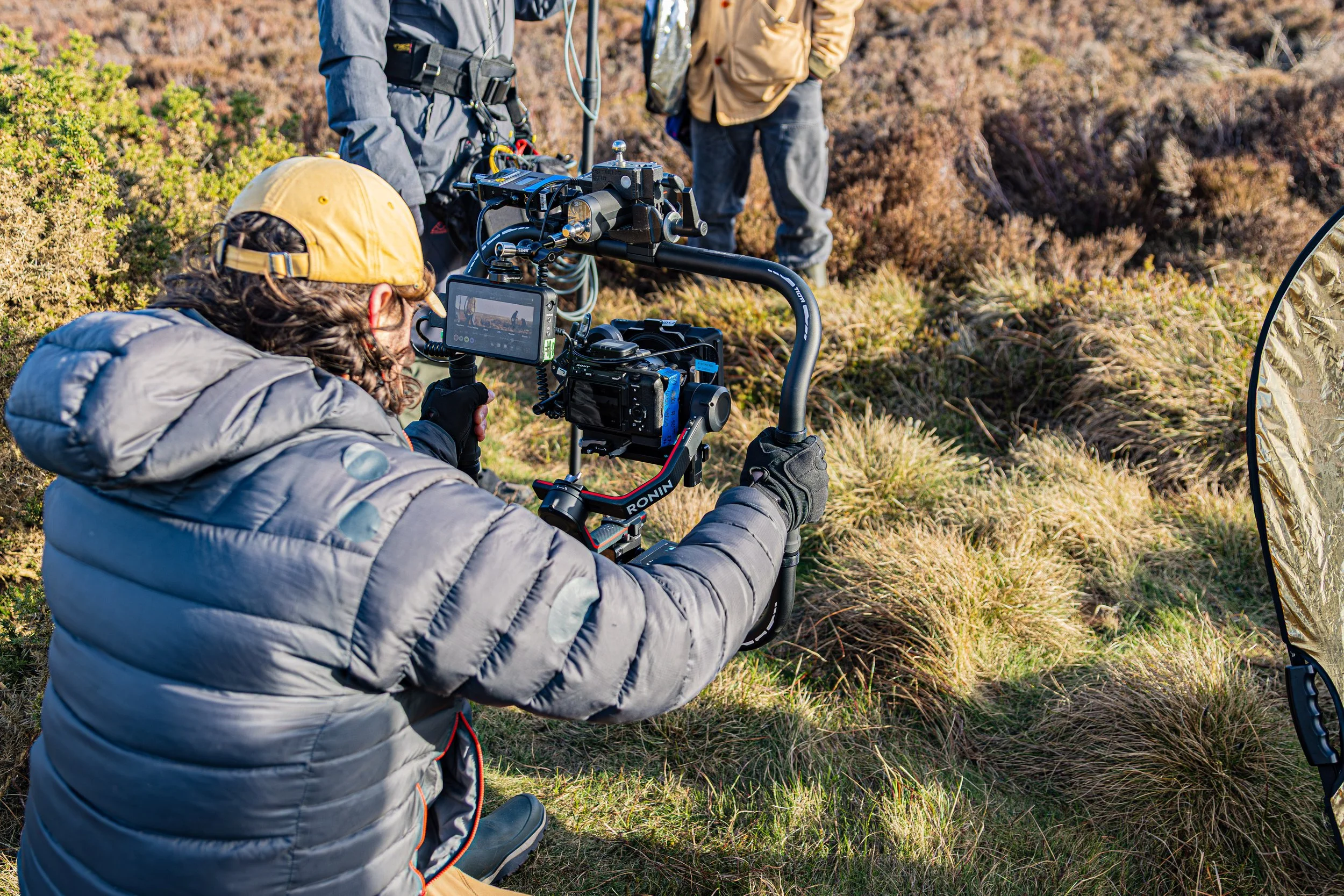
Lightweight B Camera Package - FX 3, Beetle Lenses & RS 3 Pro
Blocking & Distance
For each project, I try to develop a visual grammar. A set of principles that can guide my decisions without reducing the film to a formula, but still providing a loose visual framework. Much of that grammar I express through lens selection, which for me goes hand in hand with distance.
A lens does not create intimacy or isolation by itself. Camera position determines perspective and establishes our physical relationship with the actor. Focal length then determines how much of that relationship, and how much of the world around it, enters the frame.
A close-up photographed from nearby can allow the audience to feel present with the character. The same-sized close-up, photographed from further away on a longer lens, has a very different feeling. It can make us feel as though we are observing the character from a distance, which in essence we are, or separating them from their surroundings.
Neither approach is inherently better, but I believe they place the audience in very different relationships to the performance and the character.

Tom Langley (Dan) in Close Up
Distance also exists within the frame. Between one character and another, between a figure and the landscape, and between what is sharp and what remains out of focus. Those distances became one of the principal ways of expressing the relationship between Dan and his mum.
At the beginning of the film, Dan is physically separated from her. He walks ahead on the path, impatient, closed off and determined to control the pace. Mum follows behind, trying to connect with him and find meaning in a place that clearly matters to her.
The opening shot establishes that relationship without explaining it. Dan walks towards the camera and settles into a mid shot. On Mum’s first line, he steps aside and reveals her some distance behind him. What begins as a shot about Dan becomes a shot about the emotional space between them. In the same movement, we are introduced to his mum and given some sense of who she is on the surface.
The blocking is simple, but it carries meaning. Dan is not merely moving aside to accommodate another piece of coverage. His movement allows the film to reveal the person he has been trying not to confront. We are suddenly faced with her in a strong mid shot. Mum has been there all along, but Dan’s position has kept her from us.
Throughout the film, I used dirty frames, focus shifts and foreground-background relationships to keep the two characters connected, or deliberately misaligned. Dan might be sharp while Mum remains soft behind him. Mum might speak while Dan turns away or continues walking. One character might dominate the composition while the other survives only as a shoulder, a blur or a voice from outside the frame. They occupy the same journey and the same landscape, but not yet the same visual or emotional space.
I also used clean singles to isolate them more decisively, often placing the characters on opposing sides of the frame as their recollections of the past begin to diverge. They are remembering fragments of the same history, but they do not necessarily remember them in the same way.
I hoped to create an elastic movement between them. Dan pulls away, Mum catches up and the distance opens again. That continual separation and reconnection plays against a landscape that remains steady, dominant and largely indifferent. The characters move almost like a yo-yo within it, while the landscape, and the memories attached to it, endure.
That contrast was important. The landscape was not simply a beautiful backdrop or a succession of establishing shots. It gave their grief, regret and anger somewhere to exist beyond their faces. It allowed emotion to inhabit the space around them. At times, the landscape appears to dwarf their conflict. At others, it seems to hold the history that neither character can safely articulate.
The danger with emotional drama is that the photography can begin to explain every feeling. A close-up for pain. A reverse close-up for guilt. A wide shot for loneliness. The visual language quickly becomes diagrammatic, instructing the audience what to feel before the performance has had an opportunity to reach them.
I wanted the geography to do more of that work. Dan’s avoidance is not confined to the dialogue or to a particular expression. It is there in the simple fact that he walks ahead of his mum through a field of heather with nothing physically forcing him to do so. Mum is continually having to catch up with him, physically and emotionally. That imbalance is then reinforced through the choice of location, the landscape around them, his body position and the amount of space the frame allows between them.
This approach also had a practical value. On a short-film schedule built around uncontrollable light and weather, the blocking, composition and actors’ movement need to carry more of the scene within each frame. We simply did not have the luxury of overshooting everything.
A good example of that approach might begin in a two-shot, then allow the movement of the actors to transform it naturally into an over-the-shoulder before finally settling into a clean single. Within one piece of continuous action, we have created several changes in emphasis.
Those transitions are motivated by the characters rather than imposed through a succession of cuts and camera setups. They can be achieved relatively quickly, with light rehearsal and a handful of takes, but their value extends beyond simply keeping us ahead of the day. The shot is allowed to develop with the performance.
Similarly, once the landscape has been established as an active part of the scene, the actors can be allowed to play within a wider frame. Their pace, posture, hesitations and changing proximity carry the drama. We do not need to cut simply because somebody has delivered a line.
The result is not just efficiency. It gives the film fluidity and rhythm while retaining the shape of the performances, and gives the audience time to notice the space between the characters. Most importantly, the visual design and the practical method become the same thing. Blocking creates the emotional distance, camera position allows us to experience it and lens choice determines how that relationship sits within the landscape.
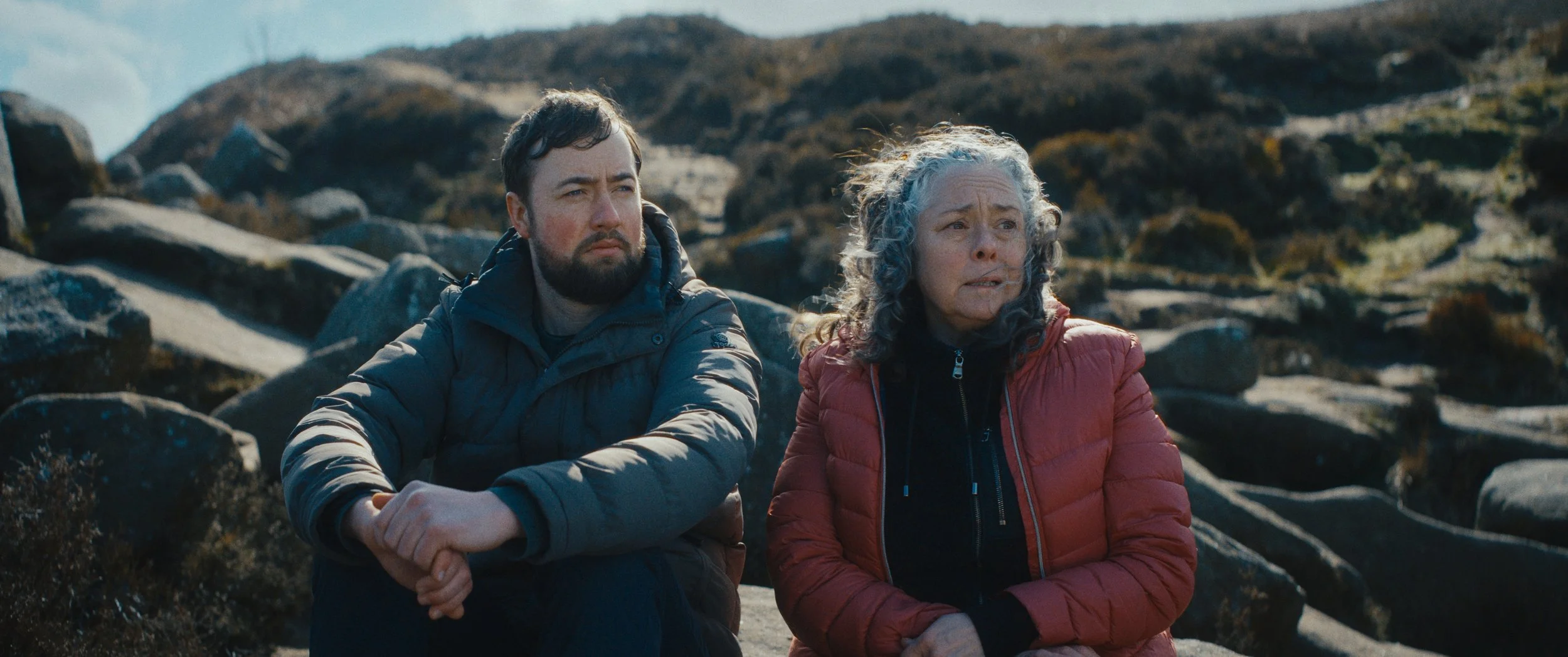
Mum & Dan’s Two Shot, The Last Hike
No plan survives first contact
The shot breakdown for The Last Hike was detailed. Very detailed in places. It included handheld approaches, gimbal moves, focus transitions, dirty frames, flashback treatments, clean singles, elevated wides and small motivated camera movements built around specific lines or actions.
That level of preparation was useful. It gave me options to present to Beth as a first-time director, and to James as someone a little more seasoned. It meant we had something concrete to react to, lean into or push against. More importantly, it gave me a way to support them in telling their story.
But maps are not territory, and no plan survives first contact with the enemy.

Blocking with Beth & James
The enemy on this occasion, as it almost always is, was time.
Once we were on location, it became clear that some of the original concepts were too intricate for the conditions. Weather, light and terrain all had a vote. So did performance. There were moments where Beth and James were clearly looking for a more continuous rhythm than I had imagined in pre-production. They wanted the audience to sit with the characters from the same angle and feel the conversation develop.
That is where collaboration becomes real. It is not in agreeing with each other during prep. It is standing in a field and working out which parts of the plan still matter.
“Time is the fire in which we burn.” It originally comes from Delmore Schwartz’s poem Calmly We Walk Through This April’s Day, though a lot of people probably know it from Star Trek Generations. It is a melodramatic line, perhaps, but on set it is brutally accurate. Time is not just a set of numbers on the call sheet. It is the combustion of your options.
I feel that very sharply on location. Every setup has a cost. Every reset, every move, every playback request. Sometimes the shot you designed in prep is now the wrong shot because the light has gone, the wind has picked up or the scene has revealed itself differently through the performance. On a short, having enough time for those conversations really matters.
As the shoot progressed, everyone became more confident with the language of the film. We shot the opening scene towards the end of the schedule, and by that point we had developed a much clearer sense of how the film wanted to move. The earlier uncertainty had settled into a rhythm we could work with or deliberately break. We knew how close the camera could be. Which lens felt right. When the landscape should dominate and when it should disappear behind a face.
That confidence allowed us to attempt some of the more intricate blocking because it no longer felt like theory. We had earned a shared shorthand. Sometimes that meant holding wider and letting the characters be small. Sometimes it meant getting close enough that the landscape fell away. Sometimes it meant allowing a dirty frame or a soft foreground to make the space feel emotionally obstructed.
By the end, the blocking brings Dan and Mum closer than they have been for most of the film. The summit scene was designed with the narrowest gap between them in the dirty over-the-shoulders, visually closing that distance before the final reveal.
As discussed earlier, the opening uses quite a specific reveal of Mum behind Dan, then holds their relationship within a shifting foreground-background composition. Earlier in the schedule, that might have felt fiddly. By the time we shot it, it felt like part of the film’s grammar.
The process teaches you how to shoot the film, or at least reaffirms what you thought you knew. Prep gets you to the first day, but production reveals the real approach through repetition, accidents and the accumulated confidence of the team.
Flashbacks & Editing
The other challenge was how to handle memory.
The script includes moments where Young Dan appears within the landscape, almost like a ghost or emotional echo. He runs from the mist, falls on the path, plays by the bridge and appears around the old tyre swing. These moments are not flashbacks in the conventional sense. They are intrusions. Dan remains physically in the present, but the landscape is triggering images he has buried.
That distinction mattered. I did not want the film to stop, announce a flashback and then enter a completely separate visual world. The memories needed to feel attached to the same places Dan is moving through now. Familiar, but slightly displaced. Present and absent at the same time.
That meant the blocking needed to connect past and present rather than separate them.
One approach I liked was repeating or closely matching frames so that absence itself became visible. In the bridge sequence, Young Dan appears within the frame, then the same or very similar composition returns without him once the memory has gone. The idea is deliberately simple. The camera does not need to announce the transition. A person disappears and the space remains.
There is something quite powerful about that for this particular story. The landscape has not changed simply because Dan left it. The bridge, the path, the tree and the river have carried on existing without him. When he returns, the memories feel less like something he is consciously recalling and more like something the landscape is giving back.
We also wanted a subtle optical distinction between those memories and the present day. In post, I developed a treatment inspired by the Deakinizer effect, using selective softness and distortion around the frame to give the memory sequences a different optical character.
The intention was not to make them look dreamy for the sake of it, or to hang a giant visual sign over the image saying “FLASHBACK”. I wanted the two realities to remain gently linked. The same landscape, the same world and often similar compositions, but with the memories feeling slightly unstable around the edges. Almost as though Dan can remember the centre of the experience more clearly than the world surrounding it.
That felt appropriate for the way memory actually works in the film. These are not complete historical records. They are fragments. Sensations, places, gestures and moments that have survived while other details have fallen away.
That is much more interesting to me than treating memory as a completely separate visual world. The past in this film is not neatly filed away. It is attached to places. A bridge. A path. A bit of rope. The old tyre swing.
The blocking and the optical treatment were therefore trying to do the same thing from different directions. The blocking ties Young Dan physically to the spaces his adult self is walking through. The post treatment gives those memories a slightly different texture without cutting them loose from the reality of the film.
There is a lovely sadness in that idea. You can leave home, build a career, move to London and become someone else, but a certain path can still put you straight back into the body of the child you were.
Of course, the final test of any of this is the edit.
You can agree a shot with the director. You can design a beautiful movement. You can feel on the day that the staging has solved the scene. Then the edit looks at it coldly and decides whether it actually works.
Cinematography can sometimes become overly precious about intention. We talk about motivation, visual grammar and emotional architecture, and all of that matters, but the cut has no loyalty. It only cares whether the scene breathes and whether it moves. If the most carefully designed shot interrupts the rhythm, it should go. If the plainest angle carries the performance, it should stay.
The same applies to the flashbacks. However carefully we designed the relationship between past and present, the transitions still had to feel instinctive in the cut. If a memory arrived too heavily, lingered too long or interrupted the emotional rhythm of the scene, then the idea was not working.
That is why I try not to think of the shot breakdown as a contract. It is more like a set of propositions I can offer to the director and editor. This might be the way to tell the story. This might be how the relationship shifts. This might be the right distance. This might be the right moment for memory to intrude.
The edit decides how well those images truly resonate.
Reflections
If I could go back and shoot the film again, I would spend more time photoboarding the entire piece.
Given the locations and relatively short prep period, I felt I could have been better prepared with the directors. We used Cadrage a little during the recce, which was useful for testing locations, blocking and lens choices, but I wish we had pushed that further, as I had on other shorts.
Not because every frame needs to be pre-visualised to death. Quite the opposite. A good photoboard should create freedom. On a location-heavy short, it can help you see where a plan is too complicated, where you are repeating yourself and where the emotional progression of the camera could be simplified before the clock starts running.
It would also have helped communicate intent more clearly across direction, camera and production.
In the end, though, the film found its language.
We quickly developed a practical approach around lensing and proximity, which I will talk about in more depth elsewhere. What mattered here was that camera distance became part of the storytelling. Not simply wide, medium or close, but observational, intrusive or intimate. How near we stood to Dan and Mum changed how near the audience felt to them.
The Yorkshire Dales are beautiful, but beauty can be a trap. Point a camera at a stunning view and it is easy to convince yourself that the image is doing more work than it really is.
For Dan, the landscape is not simply scenic. It is loaded. The cracked sign, the old farm ruin, the boggy path, the bridge, the rope in the tree, the river, the moor and finally the summit all carry something of his past. They become emotional stations along the route, each one quietly asking him to confront something he would rather leave alone.
That was always the shape of the film for me. Separation. Resistance. Collision. Stillness. Release.
The camera did not need to underline any of that. It just needed to recognise it and know when to get out of the way.
Shot design and blocking are often discussed as technical problems. Where does the actor stand? Where does the camera go? How do we cover the scene? But on this film, the useful decisions were much simpler. Keep an eye on the distance between people. Notice who is moving away and who is trying to catch up. Let the landscape carry some of the weight. Do not cut simply because you can.
And remember that the shot list is only ever a plan.
By the time our characters reach the summit, the distance between Dan and his mum has narrowed. A storm is brewing and, with ashes in his hand, the wind offers something the landscape has withheld until now. It does not erase the past, but perhaps it allows Dan to carry the weight of those memories differently.
The grief is still there. But now it has somewhere to go.
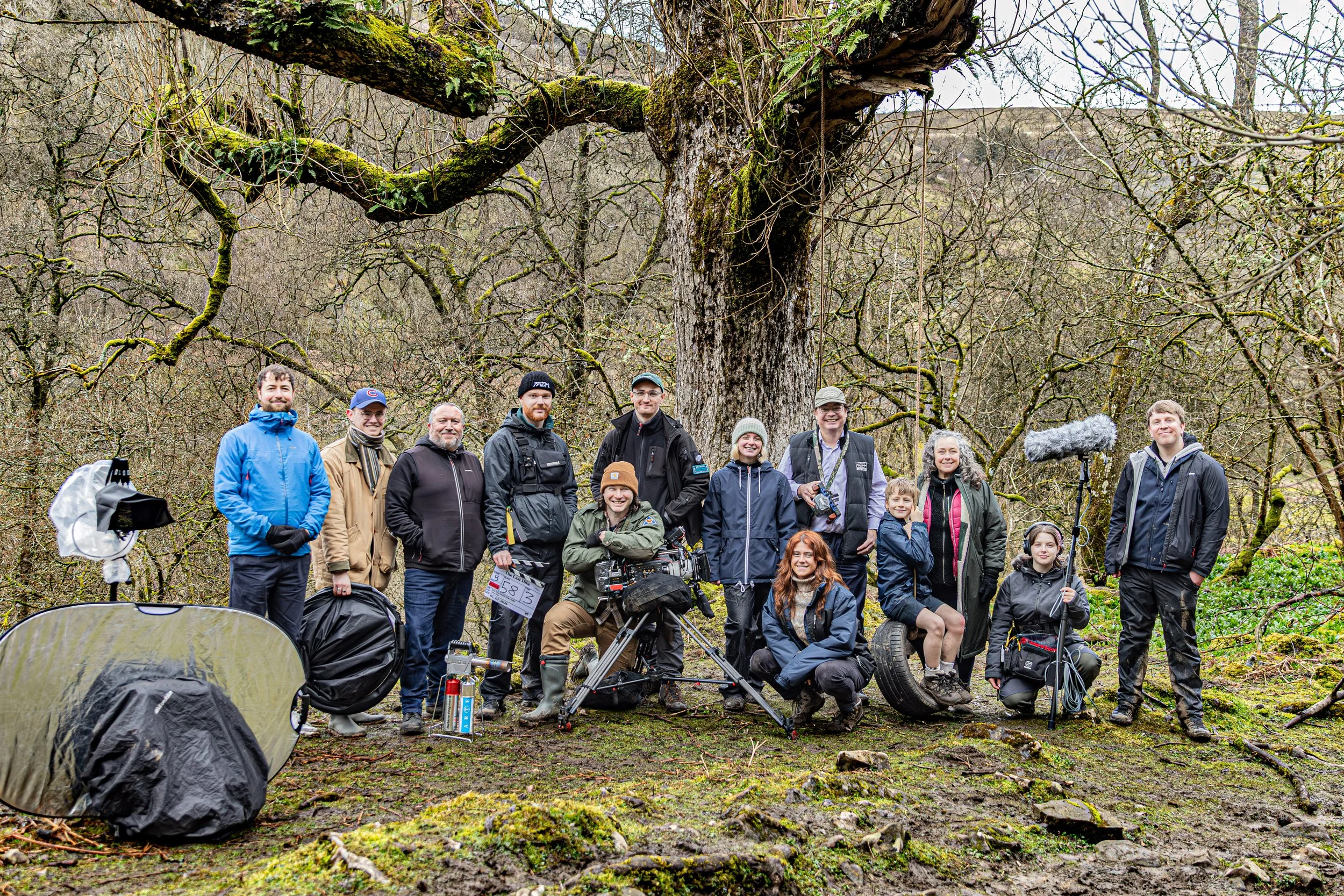
The crew, in Keld, North Yorkshire
Tom, Nial, Phil, Joe, Leo, James, Beth, James, Lucy-Mae, Kylo, Karen, Natalia, Cameron
Huge thanks to Danny Thompson and Ellen Neville for the images.